
Today #TheLariamTab carried us 16.5 miles from Boughton Station to Olney, across Northamptonshire and into Buckinghamshire.

It was a day marked not only by physical challenge, with blustery winds and yellow weather warnings, but also by reflection on the life and loss of Major General Alastair Duncan.
Major General Duncan’s military career spanned some of the most demanding peacekeeping and stabilisation operations of the late twentieth century. After commissioning into the British Army, he rose to command the United Nations Protection Force (UNPROFOR) in Bosnia in 1993, where his leadership was tested in the midst of widespread civilian suffering and institutional collapse. His calm resolve and professionalism earned him the respect of peers and subordinates alike.

He later served as Chief of Staff for the UN mission in Sierra Leone, demonstrating his commitment to international security and humanitarian intervention. His service embodied dedication to both soldiering and peace.
Despite his decorated service, Major General Duncan’s later years were overshadowed by a devastating decline in mental health. While serving in Sierra Leone in 2000, he was prescribed the anti-malarial drug Lariam (Mefloquine) despite existing medical notes documenting post-traumatic stress disorder and a traumatic brain injury sustained when his armoured vehicle struck a roadside bomb.

The known neuropsychiatric side effects of mefloquine compounded his vulnerabilities, leading to mood swings, aggression, and multiple psychiatric detentions under the Mental Health Act. His wife, Ellen Duncan, has spoken movingly about the transformation of a once-formidable leader into a man battling relentless anxiety and depression. She attributes much of this deterioration to the drug regimen imposed upon him.
Her testimony, alongside subsequent evidence to the Defence Select Committee, has prompted urgent calls for more rigorous, personalised medical assessments before prescribing neuroactive drugs to military personnel already carrying trauma.

Today’s walk passed near Northampton General Hospital, where Major General Duncan ultimately died.

As we crossed the River Nene, passed Delapré Abbey, and walked the site of the 1459 Battle of Northampton,

his story was at the forefront of our thoughts.
It is a solemn reminder that the burdens of service often extend far beyond the battlefield. His courage and leadership deserve to be remembered with respect, and his experience demands that we advocate for stronger safeguards, better mental health support, and more vigilant oversight of medical protocols, so that no veteran is exposed to preventable harm.

The miles themselves were not without obstacles. A public right of way had been fenced off by a developer, forcing a diversion until a breach was found where others had also passed.
At the Hardingstone war memorial, while filming, a passer-by stopped to learn more about the walk and generously donated £20 to our JustGiving page for the National Memorial Arboretum. Acts of kindness like this keep the momentum alive.
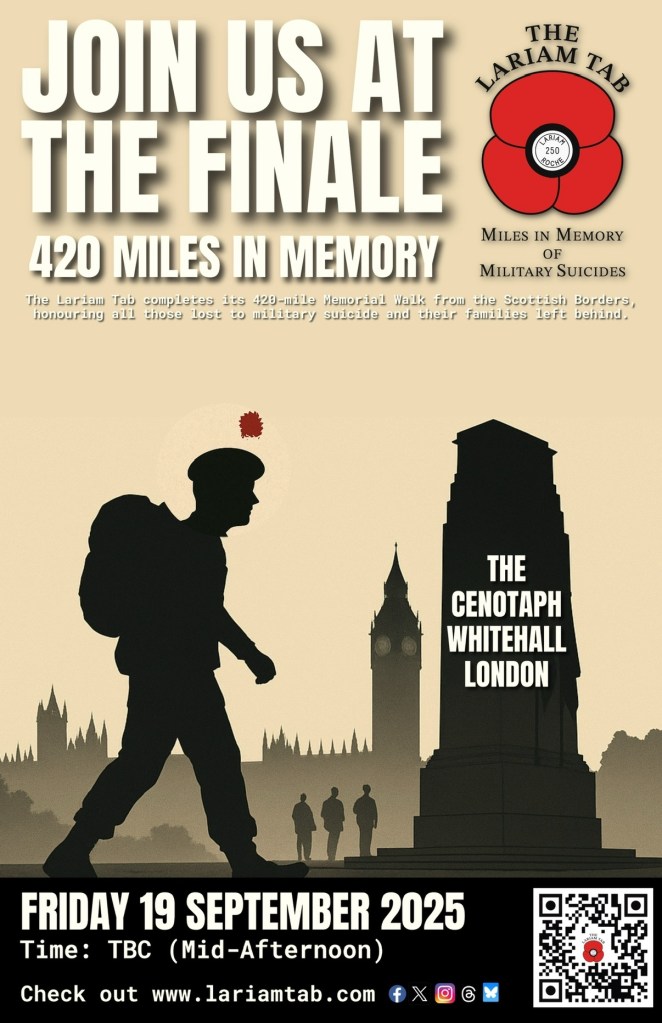
By day’s end, with 350 miles completed and only four days remaining, we had crossed into Buckinghamshire. London now feels within reach.
#TheLariamTab #MilesInMemory #MilitarySuicide
 The Lariam Tab
Leave a comment